
Desire Discrepancy & Attachment Style
Many couples have a discrepancy in their level of interest in sexual intimacy, and this does not have to create problems for the couple. Consider how you and your partner tend to address differences between you. Do you communicate with the hope of understanding your partner’s feelings and wishes? Do you communicate to try to convince your partner that you should get your way? Or do you avoid communication for as long as possible?
Couples with secure attachment are likely to stay emotionally connected, even when issues like sexual desire discrepancy arise. They can approach the difference with compassion and understanding, making space for how this disparity feels for both partners.
However, when couples bring insecure attachment into the relationship, distress often triggers old patterns of self-protection rather than connection.
Let’s explore how these dynamics might play out in the relationship when there is a sexual desire discrepancy:
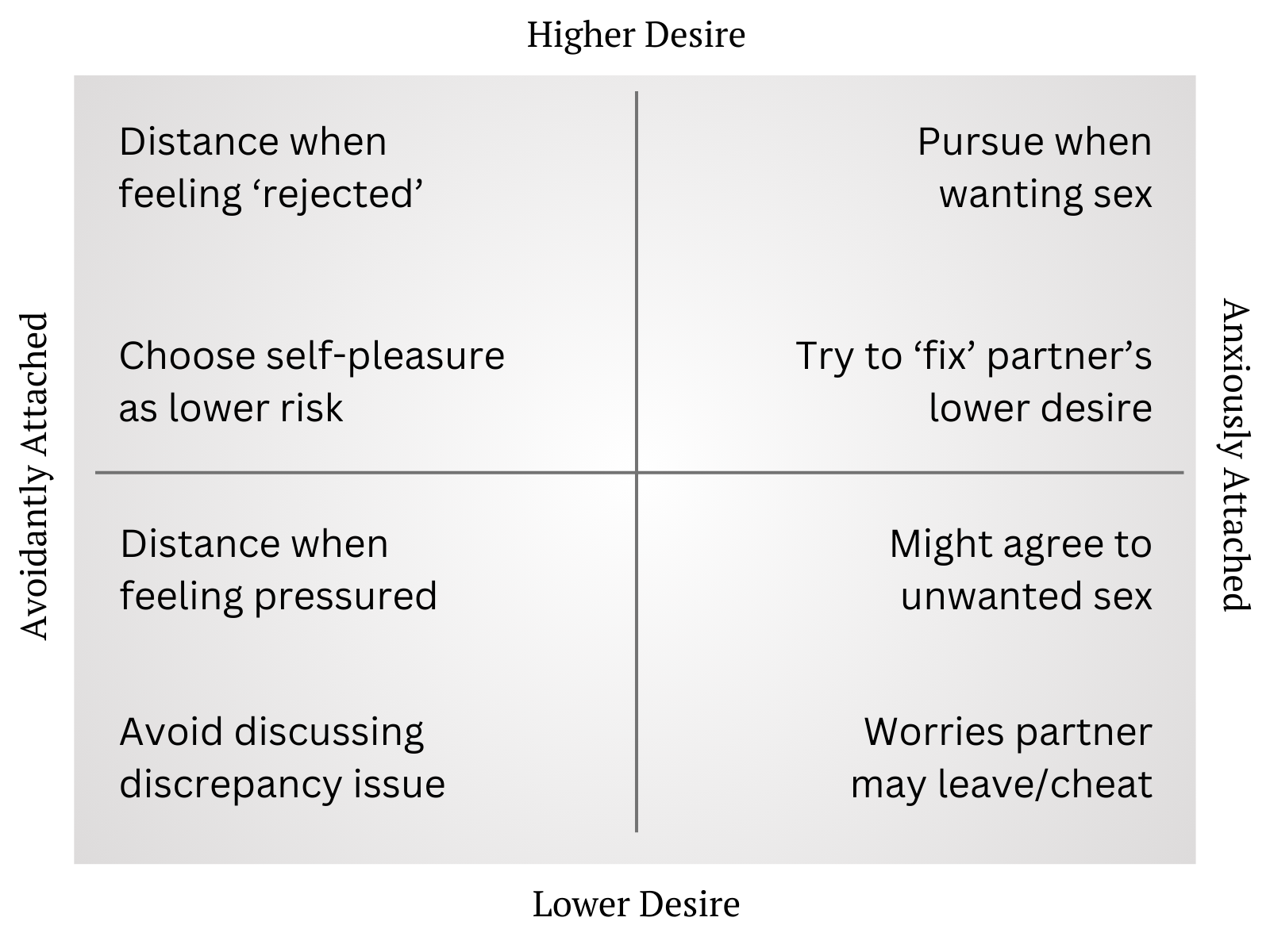
Couple 1: Higher Desire Partner with Anxious Attachment & Lower Desire Partner with Avoidant Attachment
If the higher-desire partner has an anxious attachment style, they are likely to pursue their partner for sexual intimacy, especially if physical touch is their love language.
On the other hand, the lower-desire partner with avoidant attachment may feel pressured by this pursuit. Instead of feeling closer, they may perceive their partner's efforts as overwhelming or as a burden, creating further distance.
The anxious higher-desire partner might interpret this avoidance as a threat to the relationship, potentially fixating on the desire discrepancy and growing more anxious. This pursuit-withdrawal cycle can widen the gap in sexual desire and increase emotional distance. Both partners remain stuck in patterns of self-defense rather than fostering connection.
Couple 2: Higher Desire Partner with Anxious Attachment & Lower Desire Partner with Anxious Attachment
When both partners have anxious attachment styles, they may share mutual anxiety about the desire discrepancy. Each partner wants to make the other feel loved and avoid distress, but this can create additional strain.
For example, the lower-desire partner may engage in self-criticism or self-loathing, feeling guilty if they believe they are not meeting their partner's needs. This internalized anxiety can diminish their sexual desire even further, while the higher-desire partner may feel at a loss for a solution if they worry about their partner compromising themselves.
In some cases, the lower-desire partner may agree to unwanted sexual experiences to make their partner happy. However, this does not address the root issue, and the emotional cost of this dynamic can deepen the couple’s disconnect.
Couple 3: Higher Desire Partner with Avoidant Attachment & Lower Desire Partner with Anxious Attachment
A higher-desire partner with avoidant attachment may choose to distance themselves from the issue rather than pursue resolution. They are unlikely to address the desire discrepancy directly unless their lower-desire anxiously attached partner repeatedly raises concerns about the distance between them.
Even then, the avoidant partner might only acknowledge the problem when they feel overwhelmed or emotionally upset. Instead of working through the issue together, this partner may choose to meet their sexual desires without their partner.
Meanwhile, the lower-desire partner with anxious attachment may feel increasingly insecure, repeatedly questioning why their partner is pulling away. This creates a painful cycle of pursuit and withdrawal that leaves both partners feeling unfulfilled.
Couple 4: Higher Desire Partner with Avoidant Attachment & Lower Desire Partner with Avoidant Attachment
When both partners are avoidantly attached, the desire discrepancy often goes unaddressed. Conversations about intimacy may only arise during conflicts or disagreements, but even then the topic is likely to be minimized or avoided.
In this dynamic, the higher-desire partner may choose sex without their partner to avoid the emotional risk of addressing the issue.
The lower-desire partner, meanwhile, may focus on other aspects of life such as work, hobbies, or other parts of the relationship rather than engaging in vulnerable conversations about the sexual desire gap. This avoidance perpetuates emotional and physical distance, leaving the issue unresolved.
Moving Toward Connection
Understanding how attachment styles influence your responses to a sexual desire discrepancy can help you and your partner move out of self-protective cycles. Rather than perceiving the desire gap as a personal failing or a risk to the relationship, explore what helps you and your partner feel secure. An aspect of this process is the personal work of cultivating a deeper sense of self-worth. As you are each more resilient, you have more capacity to be in open-hearted vulnerability and available for emotional intimacy with your partner. When you are communicating about relationship issues, come into the conversation with the intention of understanding your partner’s feelings and experiences, as well as their desires and boundaries. Practice staying grounded, and take breaks if you begin to feel emotionally flooded. Come back to resume the conversation after you each have had time to calm your nervous system and again feel safe to have vulnerable conversations.
Changing your relationship patterns can help you both move toward bridging the gap, deepening intimacy, and building a stronger emotional connection.
